Footfall Time Series Clustering
This project investigates how unsupervised time series clustering techniques can be applied to urban mobility data to reveal underlying patterns in pedestrian activity across Melbourne’s city centre. The analysis focuses on hourly footfall data collected through a growing network of pedestrian sensors maintained by the City of Melbourne and published via the Melbourne Open Data Portal.
We begin our analysis from 2019 onwards, using 24/7 hourly count data aggregated across multiple years. As the number of installed sensors has increased annually, the dataset provides a rich spatial and temporal view of urban movement patterns.
The primary objective is to group sensors with similar temporal profiles using clustering methods, in order to:
- Identify recurring footfall behaviours across different parts of the city.
- Understand spatial variations in pedestrian flows at different times of day, week, or season.
- Support downstream applications such as agent-based simulation, urban planning, and event response.
We employ Dynamic Time Warping K-Means (DTW-KMeans) to capture similarity across non-linearly aligned time series, and experiment with different temporal granularities—from hourly trends to aggregated monthly patterns.
Some of the core questions this project aims to explore include:
- Can we categorise sensors based on shared temporal footfall dynamics?
- What latent patterns exist in the city’s pedestrian activity?
- How do specific sensor clusters respond to events, holidays, or environmental factors?
- How might these clusters inform agent-based modelling of crowd movement?
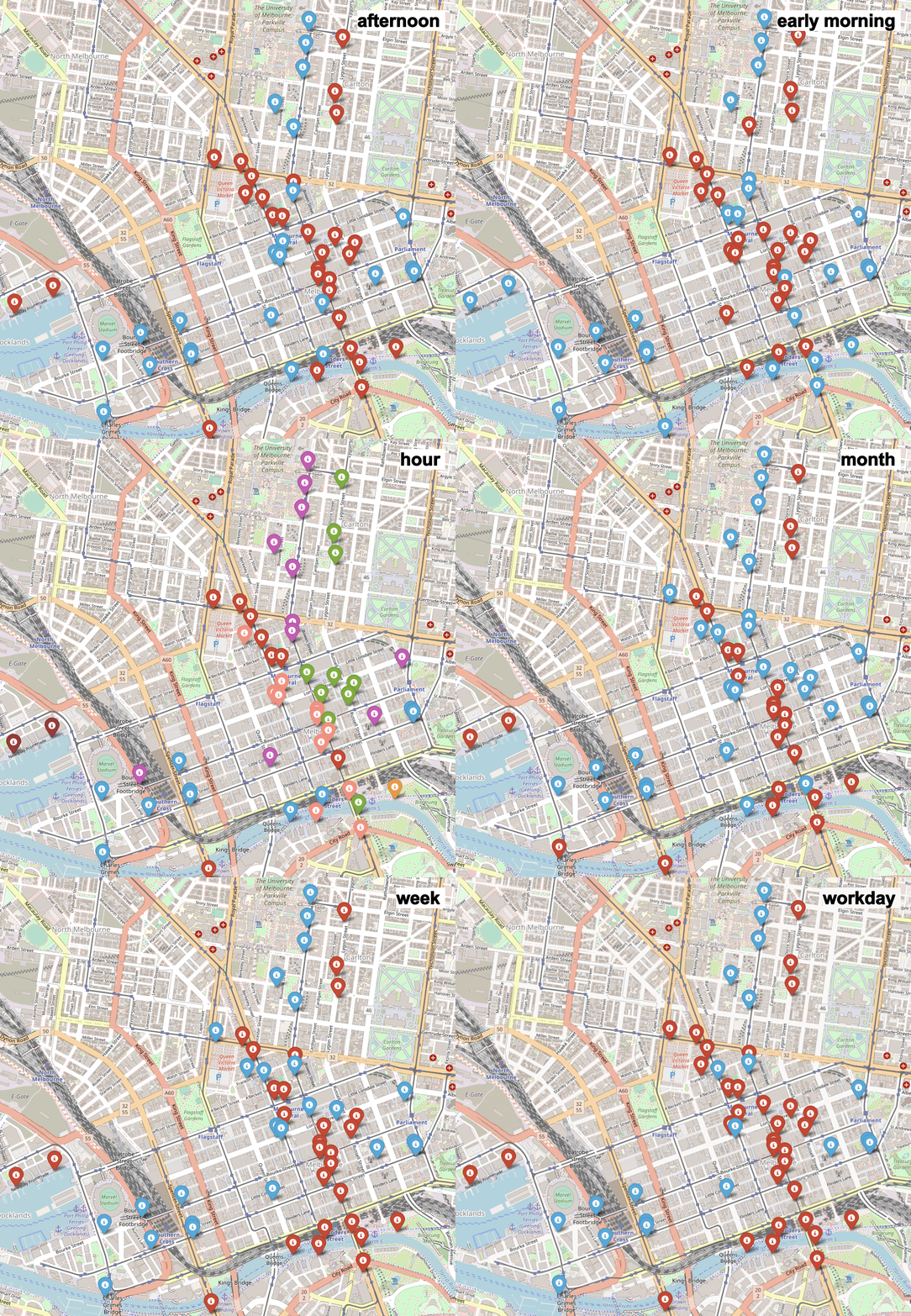
Below is a demonstration of clustering results, showing Melbourne’s sensor network coloured by cluster assignment. Sensors sharing similar footfall rhythms, based on different temporal dimensions, are grouped into the same colour category: